
More Than a Snack Bar
An Erosion of Trust (No. 107)

I was back in my hometown of Port Clinton, Ohio this past Fourth of July weekend, doing what I always do when I’m there—chasing down the places that still feel like mine, even after all these years away. On the afternoon of the 4th, that meant a few hours at the beach at East Harbor State Park, sand between my toes, Lake Erie doing its flat green summer thing out to the horizon.
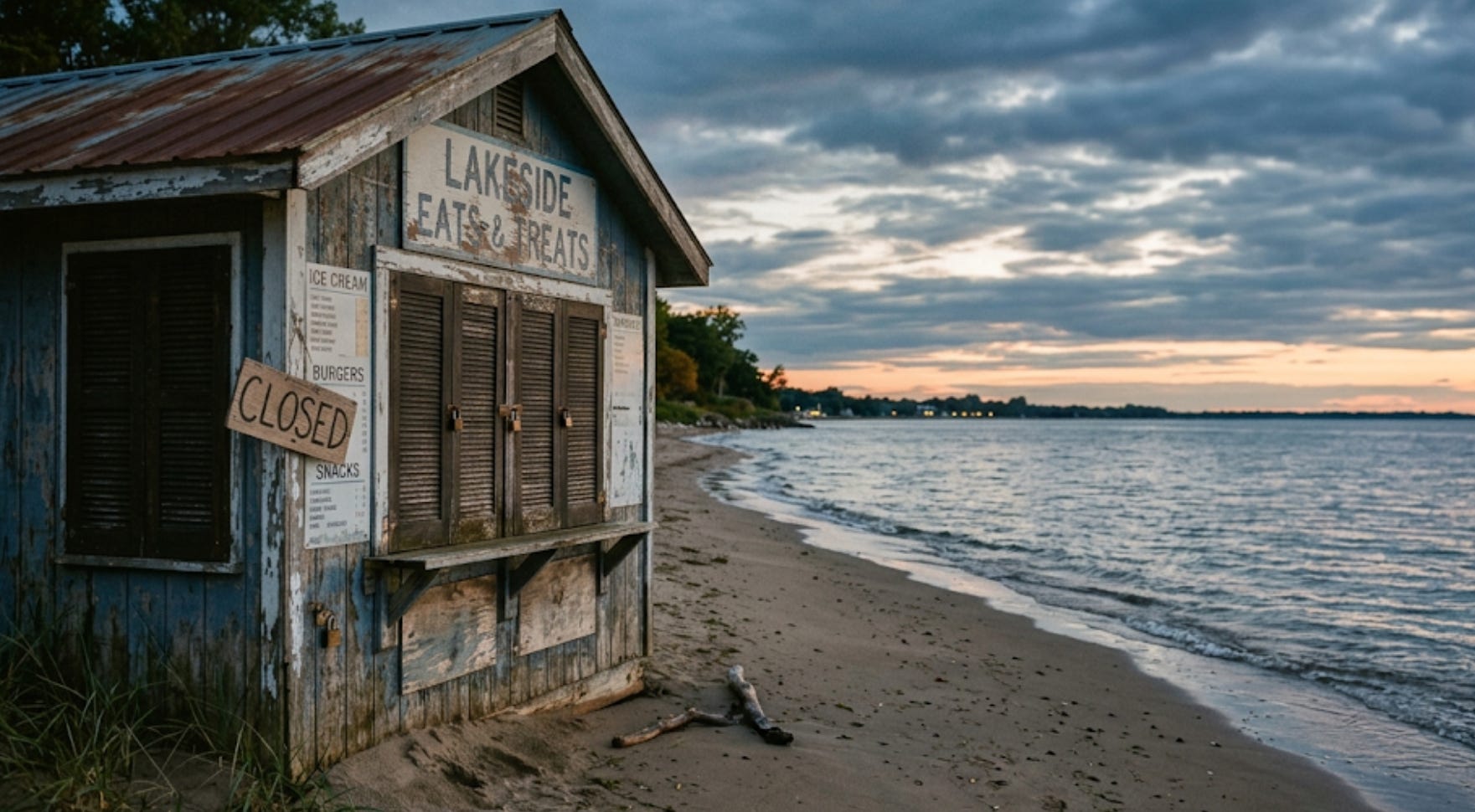
It was a busy day. The lot was full, the beach was full, and I figured—reasonably, I thought—that the snack bar would be open. It had been the last time I’d visited a few years ago, a low concrete building with a service window and a faint smell of suntan lotion and hot dogs that is part of what a lake beach is supposed to smell like.
It wasn’t open. And it didn’t look like it had been open in a while—not “closed for the holiday,” but closed the way a building gets closed when nobody’s turned the key in a couple of years. Weathered signage. That stillness a structure takes on once it stops being used for what it was built for.
I stood there a little annoyed, the way you get annoyed about small things that are really pointing at bigger things, and I found myself asking a question I’ve apparently been circling for a while without realizing it: why do parks departments keep doing this? Why build the elaborate facility—the snack bar, the bike and kayak rental, the whole amenity package—only to let it go dark, and then, a few budget cycles later, unveil “exciting new plans” for a facility to replace the one they just let die?
It’s not just an East Harbor problem. It’s not even just an Ohio problem. Down here in North Carolina, where I’ve lived for much of my adult life, Mecklenburg County Parks has built something of a reputation for exactly this pattern. The snack bar and bike rental at Jetton Park—gone. The snack bar at Blythe Landing—empty. And most striking of all, out at Latta Plantation Park, there are two separate abandoned snack bar and canoe rental sites, sitting there as a kind of accidental monument to good intentions that ran out of support.
I don’t think this is a coincidence of two unrelated bureaucracies making the same mistake. I think it’s a pattern baked into how public parks systems tend to operate, and it’s worth sitting with for a minute.
Building something is a capital project. It has a ribbon-cutting. It has a press release, a line item in a budget that a county commissioner or a state legislator can point to as evidence of investment in quality of life. Operating something, on the other hand, is a recurring cost with no ribbon to cut—staffing a snack bar, maintaining kayaks, keeping the concession contract renewed, replacing the refrigerator or the grill when it breaks. It’s unglamorous. It’s the kind of expense that’s easy to trim in a lean year because nobody loses an election over a closed snack bar, at least not directly. So the amenity gets built with fanfare and maintained with indifference. Eventually, it just stops—not with a decision so much as a slow withdrawal of attention, until one day a guy standing on a hot beach in Ohio realizes the snack bar’s been dark for years.
And then, because the underlying idea was good—people do want a place to buy a cold soda on a hot day—someday a new administration or a new grant comes along, and the whole cycle starts over. New rendering. New press release. New ribbon. Nobody in the room asks what happened to the last one because asking that question is a little embarrassing and because, by then, most people in the room weren’t there for it.
What gets lost in all of this isn’t really the Pepsi and Snickers. It’s trust—the quiet, straightforward kind of trust a visitor builds up over years of returning to a place. I’ve been going to East Harbor since before I could drive myself there—heck, since before I could ride a bike. I have a mental map of that park that includes things that no longer exist, and every time I come back and find another one of them gone, the map gets a little less reliable. Multiply that by however many families showed up to that beach on the Fourth of July expecting to buy their kids a hot dog and a bag of chips, and you start to see the actual cost of deferred maintenance—not in dollars, but in the low-grade erosion of the feeling that a public place is being looked after.
I don’t have a tidy fix for this. Parks departments are underfunded almost everywhere, and I understand that operating budgets lose out to capital budgets because that’s how public money tends to work. But I’d settle for something smaller than a fix: an honest accounting. If a county or a state is going to build the next kayak rental at Latta, or the next snack bar at East Harbor, I’d like someone to stand up first and explain what happened to the last one—not as an apology, necessarily, but as a way of proving they’ve actually reckoned with the pattern before asking us to believe in the next rendering.
Until then, I’ll keep showing up when I’m in town, hopeful and a little foolish, checking to see if the window’s open.